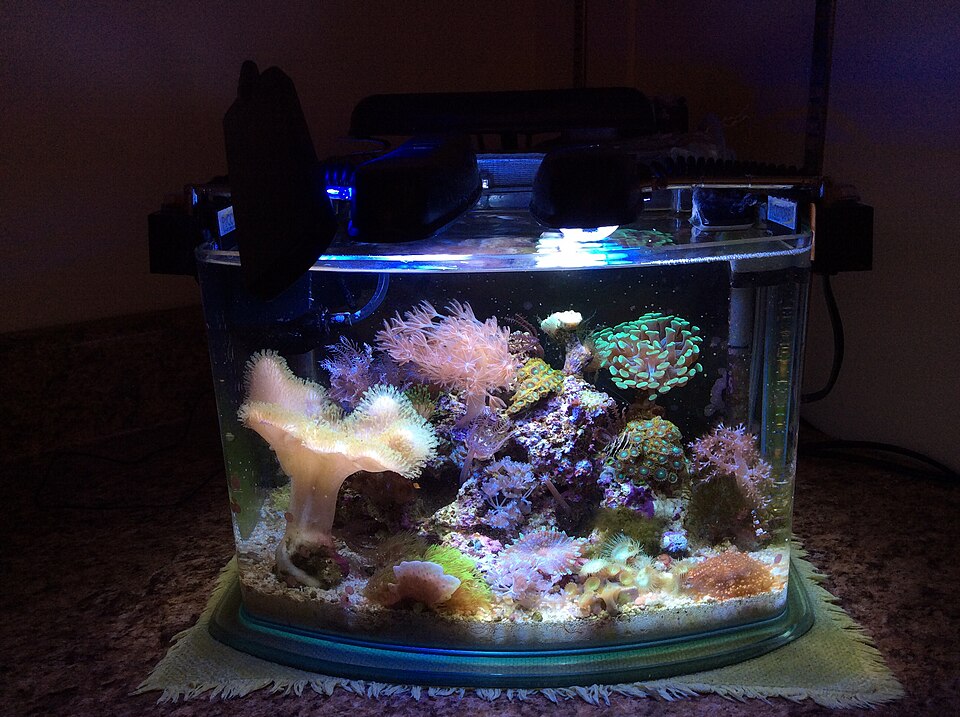
I was so deep into comparing lights, pumps and rock that it took me way too long to realise salt wasn't even on the shopping list. For a saltwater tank. Yeah.
The salt
Reef salt isn't table salt. It's a mix that recreates seawater, including the minerals corals use to grow, like calcium, magnesium and the stuff that keeps alkalinity stable.
I got a 4 kg pack of standard Red Sea Salt for S$21. Red Sea also does Coral Pro, a higher-alkalinity mix aimed at stony corals. My tank is soft corals and macroalgae, so standard is plenty.
Is 4 kg enough? The tank is 81 L on paper, but once the rock and sand are in, the actual water is probably more like 65-75 L. At roughly 38 g of salt per litre (Red Sea's own mixing guide), that's around 2.5-2.9 kg for the first fill, with a bit left over for the first water changes.
You don't mix by weight alone though. You measure salinity, and that's what the YASAM refractometer (S$14.76) is for. You drop some water on it, look through it like a tiny telescope, and read the salinity off a scale. One thing I learnt: calibrate it with a proper seawater reference fluid, not just plain RO water, or your reading at reef salinity can be off.
Cycling, saltwater edition
Same as freshwater, the tank has to cycle before anything lives in it (more on the nitrogen cycle here). The bacteria need ammonia to grow, so you have to feed an empty tank.
A lot of people buy bottled ammonia for this. I'm doing it the lazy way: ghost feeding. I just drop fish food into the empty tank, it rots, and that makes the ammonia. I already have fish food, so it costs nothing. It's slower and less precise than bottled ammonia (DrTim's fishless cycling guide explains both), but I'm not in a rush.
To speed things up, I got six vials of Prodibio BioDigest (S$18) to seed the bacteria. I spent an embarrassing amount of time comparing bacteria bottles before settling on these small sealed vials. But a bottle of bacteria doesn't mean the tank is cycled. Only test results tell you that.
Can I reuse my old API test kit?
This was the plan. I have an API test kit from my freshwater days, and some API tests do work for saltwater with a separate colour chart (the ammonia test is one).
Then I actually dug it out. Expired in 2024. So much for that.
So new tests are on the list: ammonia, nitrite and nitrate at least, so I can actually see the cycle happen. Glad I checked before trusting expired reagents and wondering why my numbers looked weird.
Tank pickup is tomorrow!!
xo, yy
Some links in this article are affiliate links. I may earn a commission if you buy through them.